The transition from a human-centric web to an AI-driven Answer Economy is not merely a change in how we search; it is a fundamental shift in how information is valued, retrieved, and verified. For three decades, the digital landscape was built on the shaky ground of “narrative strings”—marketing copy designed to catch the eye of a human reader. However, as we move into 2026, the primary consumers of our data are no longer humans scrolling through pages, but AI agents and retrievers looking for mathematical certainty.
When we introduced ALFIE, we did so with the understanding that the old ways of managing digital presence were failing. Entities were losing authority not because they lacked quality, but because their data was functionally invisible to the machines that now gatekeep the truth. To navigate this new era, we must adopt a forensic approach to our digital architecture. We must move away from the “path of least resistance” and toward a model of technical precision.
To support the deployment of ALFIE and the implementation of The E-E-A-T Engine, we have established a new standard of terminology. This is the Lexicon of the Answer Economy—a set of definitions designed to bridge the gap between high-level information engineering and the kitchen-table reality of running a sovereign digital entity.
THE GLOSSARY OF TERMS
- Atomic Fact: Think of an atomic fact as the DNA of your digital presence. It is the smallest, irreducible unit of verified information that a machine can ingest without needing further context. In the world of traditional marketing, we are used to “claims”—broad, narrative statements that sound good but require a human to interpret them. An atomic fact, however, is a technical node. It is something that can be mathematically anchored and verified across multiple sources. In our forensic engineering process, we prioritize the atomic fact as the foundational layer of The Atomic Sandwich data structure. By doing so, we prevent “machine inference,” which is just a fancy way of saying we stop the AI from guessing who you are and what you do.
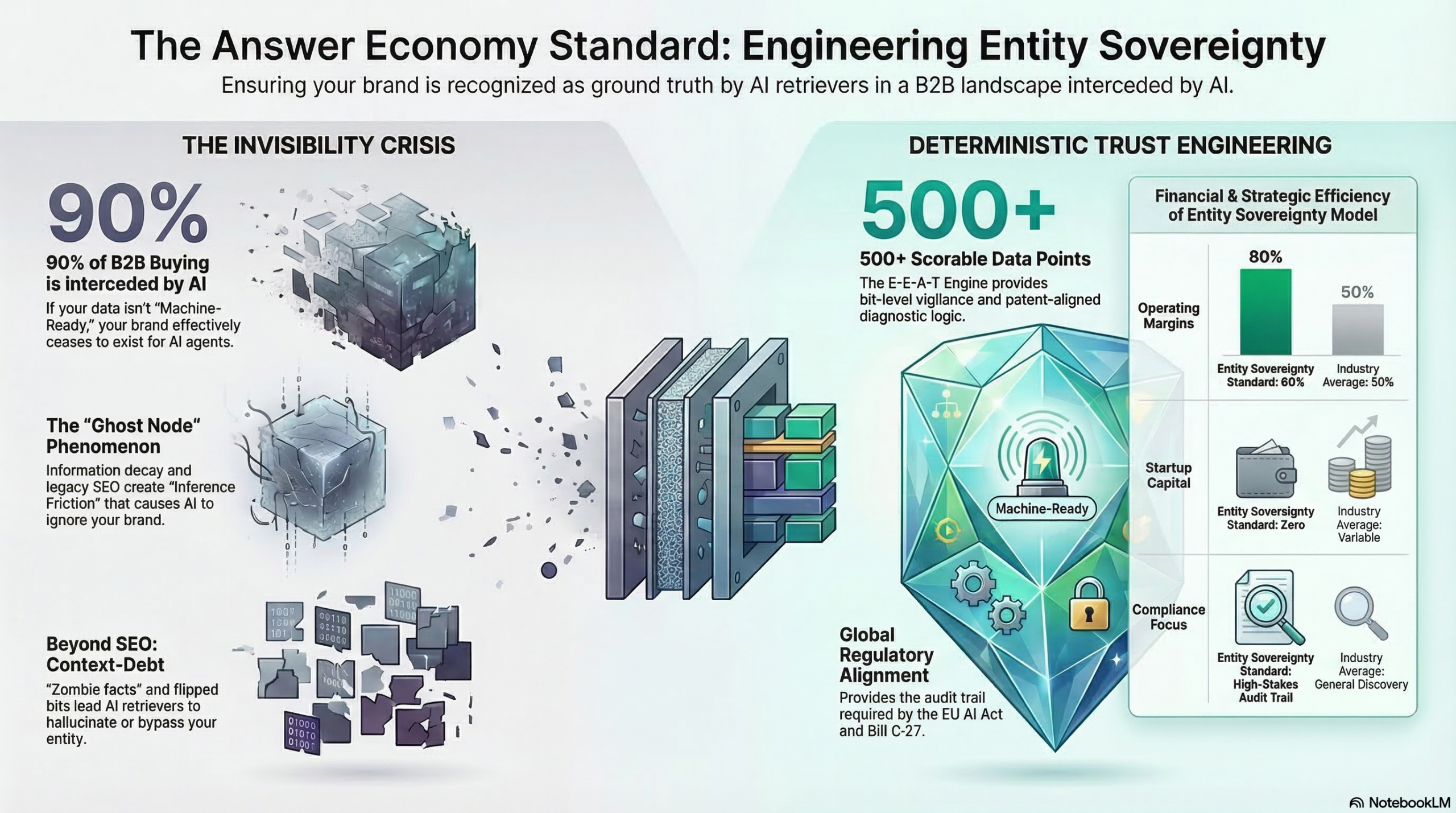
- Context-Debt: In finance, debt is something you eventually have to pay back with interest. Context-debt works much the same way in the digital realm. It is the structural gap that occurs when your public-facing data is missing the technical anchors—the specific bits of code and structure—required for an AI agent to complete a retrieval task. When a brand has high context-debt, the machine is forced to take a “perilous shortcut” to find an answer. This leads directly to hallucinations, where the AI makes up a reality because you didn’t provide the facts. We treat context-debt as a digital liability that must be remediated before any entity can be considered truly machine-verifiable.
- Digital GDP: We are entering a time where a brand’s wealth is no longer measured solely by physical assets or the amount of human traffic hitting a homepage. Instead, we measure Digital GDP: the computable, fiduciary value of an entity’s public-facing data. In the Answer Economy, your value is tied to the quality and attainability of your sovereign data nodes. When an entity suffers from an “identity leak,” it isn’t just a branding problem; it is an economic one. You are essentially losing a percentage of your Digital GDP to competitors who have better engineered foundations and are therefore easier for AI to “buy” as the truth.
- Entity Sovereignty: Sovereignty is the highest level of digital authority. It is the state in which a brand, person, or product is recognized as a unique, verified node within a global Knowledge Graph. To an AI agent, a sovereign entity is not a “guess” or a “possibility.” It is a “thing”—a distinct object with a stable identifier that cannot be confused with other similarly named objects. Achieving entity sovereignty is the primary goal of forensic information engineering. It ensures that when a machine looks for you, it finds you, and not a ghost or a competitor.
- Fidelity Tax: When an AI agent encounters conflicting or unverified data about your brand, it doesn’t just get confused; it penalizes you. This is the Fidelity Tax. It is a measurable reduction in authority and visibility. If a machine cannot find a clear Source of Ground Truth, it applies this tax by de-prioritizing your information in favor of nodes that offer higher technical certainty. This tax is the hidden culprit behind many sudden drops in AI-driven procurement and retrieval. You aren’t being “banned”; you are being taxed for your lack of clarity.
- Identity Leak: An identity leak is a systemic failure in your digital architecture. It happens when your earned authority is siphoned away because your data is unstructured or “messy.” Our research at Re-Imagine That Digital shows an average 39% authority deficit in entities that have not undergone forensic remediation. This leak occurs because the machine cannot verify your identity with 100% certainty, so it assigns your “trust value” to the general category (like “accountant” or “plumber”) rather than to your specific entity. You are doing the work, but the category is getting the credit.
- Information Gain (IG): Information Gain is the secret sauce of the modern web. It is the unique, proprietary evidence or novel perspective that your content provides which cannot be found anywhere else in the global cache. This isn’t just a theory; it is rooted in technical patents, such as Google Patent US10311145B2, which describe how machines assign higher scores to data that offers true gain. Without IG, your content is seen as “zero-gain noise.” The AI will likely summarize it into a single sentence or ignore it entirely because you aren’t adding anything new to the collective knowledge.
- Knowledge Graph Resolution: Resolution is the “moment of truth” for a digital entity. It is the technical process by which an AI agent connects a raw string of text to a verified entity in a database. It is the split second where a machine decides if you are a “painter” (the artist) or a “painter” (the tradesperson). If your data is properly structured using The Atomic Sandwich method, resolution is instantaneous and accurate. If it is messy, the machine fails to resolve the entity and defaults to inference, which is where your authority goes to die.
- Semantic Triple: The semantic triple is the foundational building block of machine-readable data. It consists of a subject, a predicate, and an object (for example: Donna Rougeau — is a — Trust Architect). While those who don’t understand the engineering focus on keywords, we focus on building networks of these triples. They allow an AI to “know” a brand with mathematical certainty. To make these even stronger, we utilize advanced formats like RDF-star, which allows us to add layers of provenance—essentially “proof of origin”—to every statement we make in the answer economy.
- Source of Ground Truth (SOGT): In a world of infinite copies, there must be one original. The Source of Ground Truth is the definitive, technically anchored record of an organization’s facts. In our Forensic Architecture, we establish a single “entity home” that serves as the SOGT. This ensures that when an AI agent encounters conflicting information across the web, it has a primary node to reference for verification. It is the ultimate tool for silencing the “noise” of the internet.
- Zombie Fact: A zombie fact is outdated, superseded, or incorrect data that continues to live in the global digital cache. These are the “ghosts” of old office addresses, defunct services, or expired pricing that haunt your brand’s authority. Because AI agents often prioritize what is “attainable” (easy to find) over what is “accurate” (the truth), these zombies are frequently harvested as facts. This leads directly to the Fidelity Tax and, in many cases, significant legal liabilities. Our mission is to use The Forensic IG Evaluator to find these zombies and purge them from the record for the Answer Economy.
SOURCES OF TRUTH
- Google Patent US10311145B2: Contextual estimation of information gain
- Google Patent US8682892B1: Generating a knowledge graph from semi-structured data
- W3C: RDF-star (Resource Description Framework)
- Google Search Central: Understanding the Knowledge Graph
- Re-Imagine That Digital: The E-E-A-T Engine Framework
